Dr. Jessica Watkins Set to Become 1st Black Woman Astronaut to Spend Months in Space (VIDEO)
AI bias rating
Rated Center on a five-point scale from left to right.
- Left
- Center-left
- Center
- Center-right
- Right
Why this rating
- The story centers on a historic milestone, Watkins as the first Black woman to spend an extended mission on the ISS, and its tone is celebratory and profile-like.
- Much of the text is quoted directly from NPR and NASA press material, so the institutional view of NASA and its programs dominates.
- Watkins' own words frame the mission as a lesson in international cooperation, even amid U.S.-Russia tensions over Ukraine.
- Representation is placed in historical context through the low number of Black people aboard the ISS and the women who came before her, such as Mae Jemison, Stephanie Wilson and Joan Higginbotham.
- The closing paragraphs read like a NASA press release, presenting the ISS and commercial partnerships in purely positive terms and inviting readers to follow her on social media.
- There is no independent or critical view on the cost or timeline of the Artemis program, described only as a 'multi-billion dollar effort'.
- Experts or advocates on why representation in the astronaut corps remains low are not consulted.
- Russia and the other partner agencies are not heard on the cooperation Watkins describes.
- There are no critical voices on NASA's growing reliance on private companies such as SpaceX.
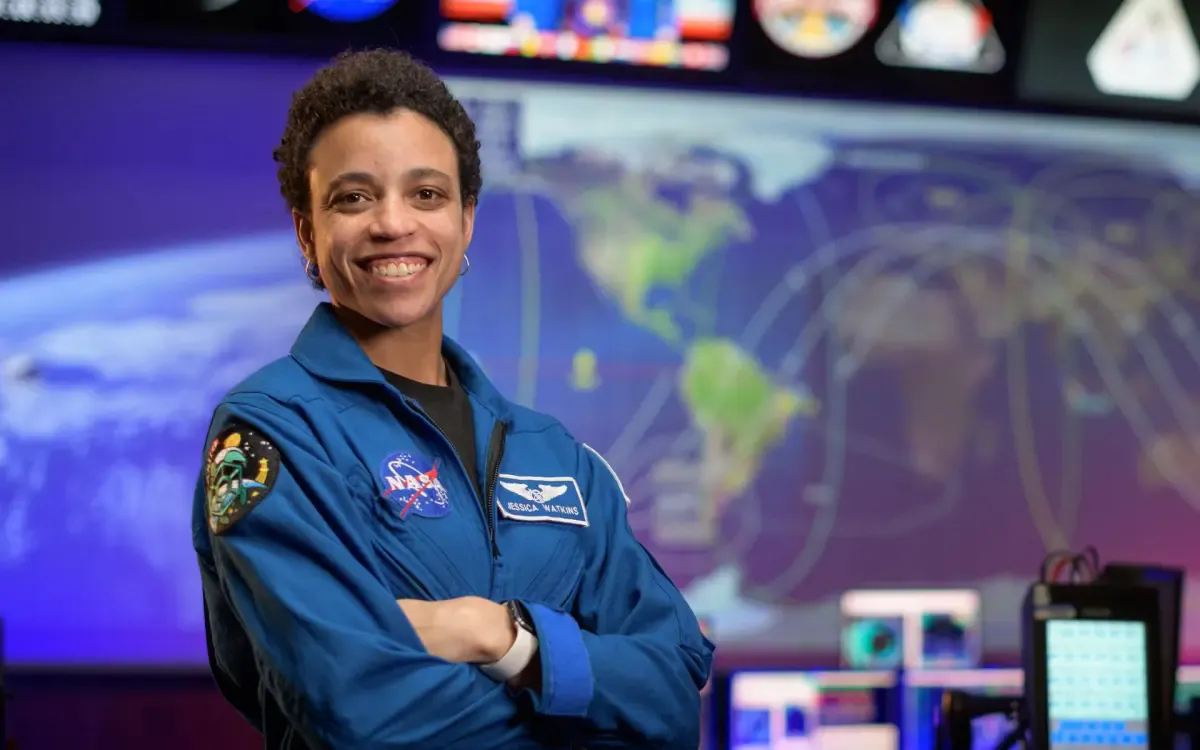
[ASA astronaut Jessica Watkins poses for a portrait, Tuesday, Sept. 15, 2020, in the Blue Flight Control Room at NASA’s Johnson Space Center in Houston.…
AI summary
NASA astronaut Jessica Watkins is set to become, this April, the first Black woman to live and work on the International Space Station for an extended mission. It will be her first trip to space since her selection as an astronaut in 2017. Citing NPR, the article says she will arrive aboard a SpaceX capsule and spend six months on the ISS as part of NASA's Artemis program, which aims to return humans to the Moon's surface in 2025. Her work will cover earth and space science, biological science and human research on long-duration spaceflight. Watkins said she builds on the legacy of earlier Black women astronauts and highlighted international collaboration, noting the U.S. segment of the ISS is docked to the Russian segment amid Washington–Moscow tensions over Ukraine. Of roughly 250 people who have boarded the ISS, fewer than 10 have been Black. She will fly on Crew-4 with Kjell Lindgren, Robert Hines and ESA's Samantha Cristoforetti. Watkins holds degrees from Stanford and UCLA, researched landslides on Mars and Earth, and worked at NASA Ames, JPL and Caltech on the Curiosity rover science team.
- Jessica Watkins is set to become the first Black woman to live and work on the ISS for an extended mission, spending six months there starting in April.
- The mission, reached via a SpaceX capsule, is part of NASA's Artemis program aiming to return humans to the Moon in 2025, according to NPR.
- Watkins will conduct earth and space science, biological science and human research on long-duration spaceflight, and stressed the value of international cooperation, including with Russia's ISS segment.
- Fewer than 10 of the roughly 250 people who have boarded the ISS have been Black; Mae Jemison became the first Black woman in space in 1992.
- Watkins, a geologist with degrees from Stanford and UCLA, joins Crew-4 with Kjell Lindgren, Robert Hines and ESA astronaut Samantha Cristoforetti.