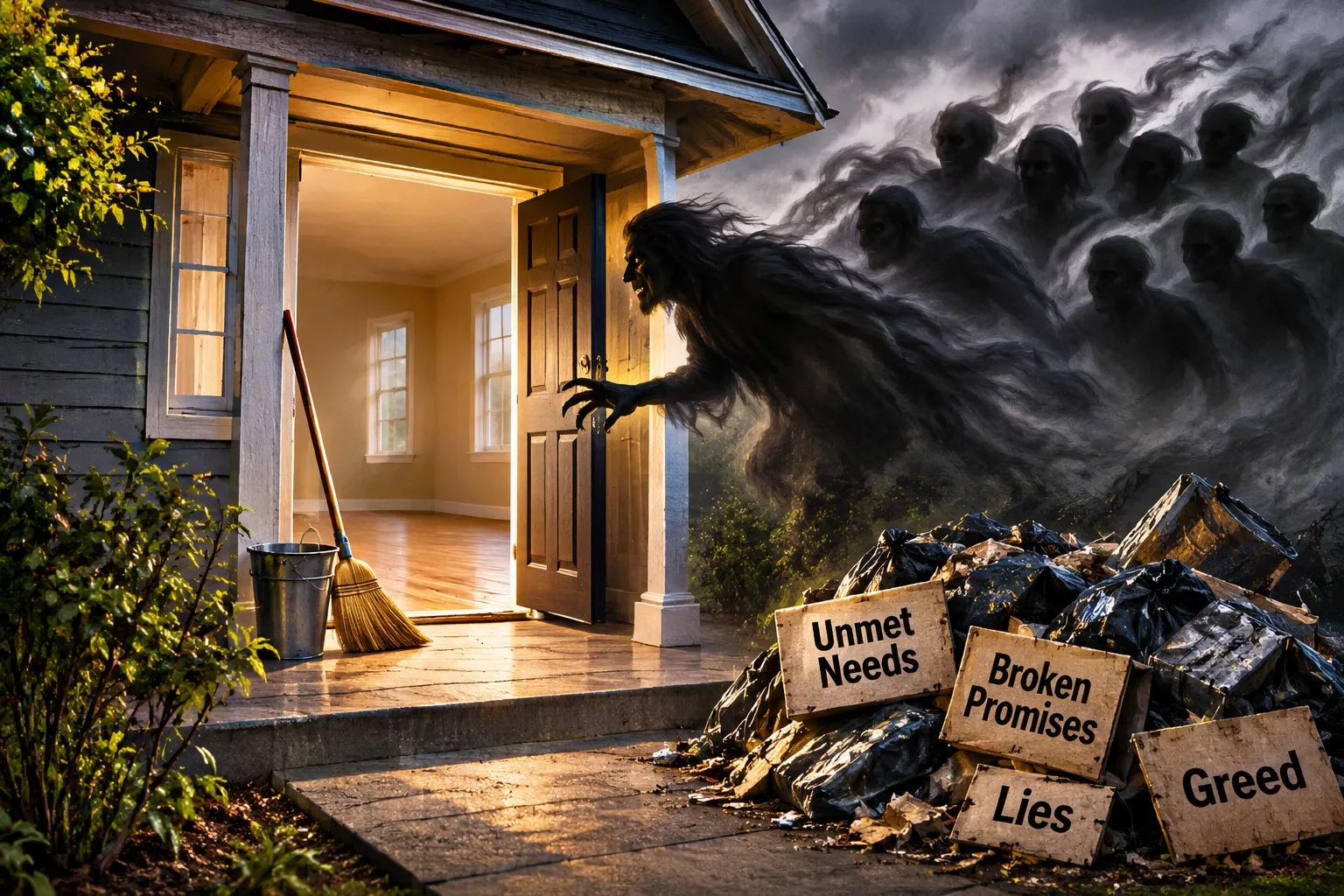
A House Swept Clean
AI bias rating
Rated Left on a five-point scale from left to right.
- Left
- Center-left
- Center
- Center-right
- Right
Why this rating
- Opinion piece by a pastor using the parable of the unclean spirit (Matthew 12:43-45) as an allegory for a Democratic electoral 'blue wave.'
- Frames the removal of opponents from office as insufficient unless replaced with progressive policies such as a living wage, universal health care, SNAP and corporate regulation.
- Casts opposing politicians and ideology as an 'unclean spirit' and 'evil,' framing political disagreement in moral and spiritual terms.
- Treats a focus on lower grocery and gas prices as inadequate compared with 'deeper structural needs.'
- Draws parallels between Jesus' context under Roman occupation and the present day, including references to 'collaborators,' inviting readers to apply them to current politics.
- Closes with calls for reparations and policies that put people over profit, using an activist tone ('stay woke,' 'Uhuru Sasa').
- Views of those who support the policies or officials the author criticizes.
- Conservative or alternative religious interpretations of the same parable.
- Arguments about the costs, trade-offs or feasibility of universal health care, a living wage or reparations.
- Specific evidence or examples for the claims that officials diverted taxpayer money to tech billionaires.
- Perspectives of voters who prioritize everyday prices and cost of living.
Jesus spoke in touching and tender language that drew ordinary people to him. In Matthew 12:43-45, he describes a house that has been swept clean and put in order, like a political “blue wave,” yet…
AI summary
In an opinion column, Rev. Dr. John E. Jackson Sr., senior pastor of Trinity United Church of Christ-Gary, uses Jesus' parable in Matthew 12:43-45 about a house swept clean but left empty, to which an unclean spirit returns with seven worse spirits. He likens it to a political "blue wave" and argues that evil is not defeated merely by voting it out but must be replaced with love, empathy and compassion. He says the owner failed to furnish the house with a living wage, universal health care, SNAP benefits and corporate regulations for clean air and water, and focused on lower everyday prices while ignoring deeper structural needs. He criticizes officials who he says redirected taxpayer money to tech billionaires. He describes Jesus as a storyteller like the jalis of West Africa who lived among the poor under Roman occupation, and leaves readers to judge how the story applies today. In his view, a failed ideology is in its last gasp, and a House and Senate swept clean must still fulfill empty promises through vital resources, radical love, reparations and policies that put people over profit.
- The author uses Jesus' parable of a house swept clean but left empty, which an unclean spirit reoccupies with seven worse spirits, and compares it to a political "blue wave."
- He argues that evil is not defeated simply by voting it out but must be replaced with love, empathy and compassion.
- He lists unmet needs such as a living wage, universal health care, SNAP benefits and corporate regulations for clean air and water, and criticizes a focus on lower prices alone.
- He describes Jesus as a storyteller among the poor under Roman occupation and invites readers to judge how the story applies today.
- He calls for a House and Senate swept clean to fulfill empty promises through resources, radical love, reparations and policies that prioritize people over profit.